
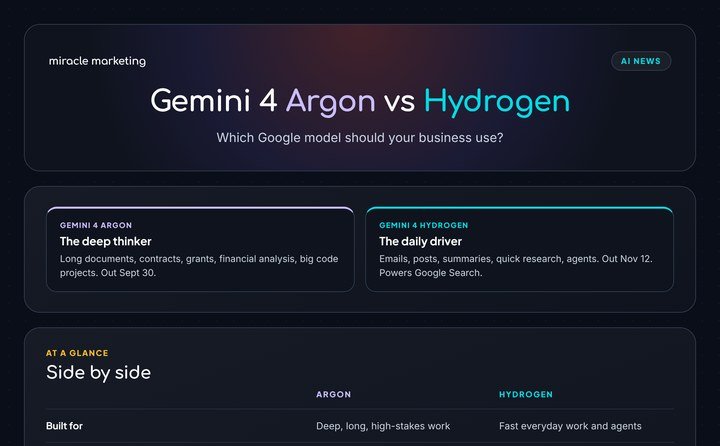
Google now has two Gemini 4 models that most people will actually run into: Argon and Hydrogen. The names don't explain much, and the launch posts are full of benchmark scores. If you run a business, a church, a school or a nonprofit, you need three answers: what each one is good at, what it costs you, and which one to open on Monday morning. That's what this article covers.
Short version: Hydrogen is the everyday model. It's fast, cheap and already working for you in Google Search. Argon is the specialist you call in for long, high-stakes work. Most readers should start with Hydrogen and switch to Argon only when a task really needs it.
What is Gemini 4 Argon?
Google announced Argon on September 30, 2026, and called it its frontier model for "real-world coding, enterprise knowledge work, and cyber defense." It went first to a small group of vetted security teams. Paying developers got access on October 13, and so did Google AI Pro and Ultra subscribers in the Gemini app (in select countries).
Argon is designed for long tasks with many steps, where a mistake is expensive:
- Long documents and analysis: contracts, policies, grant applications, financial research.
- Big software jobs: debugging and moving large codebases.
- Very long answers: it can write up to 1 million tokens in one response. Earlier Gemini models stopped at about 64,000.
- Fewer made-up facts: on Artificial Analysis' AA-Omniscience test, Argon's hallucination rate was 15%. That was the lowest among the top-scoring models at the time.
What is Gemini 4 Hydrogen?
Hydrogen launched on November 12, 2026. Google calls it its "daily driver," and its own one-line pitch is "Carbon and Argon do the deep thinking. Hydrogen gets the everyday work done, fast." Carbon is Google's other deep-thinking model, opened to Ultra subscribers and developers on November 10.
Unlike Argon, Hydrogen is available to everyone from day one:
- Google Search runs on it, worldwide.
- The free Gemini app uses it automatically when Google decides it suits your question. Paid users can pick it from the model menu.
- Developers can use it in the Gemini API and AI Studio, including a rate-limited free tier.
- Gemini in Google Sheets is coming, starting with AI Pro and Ultra.
According to Google, Hydrogen finishes tasks 2.5 times faster than the Gemini 3.8 Flash model it replaces, and makes more than five times fewer fabricated claims. It takes text, images, audio and video, and has four thinking levels, from low up to a new "xhigh."
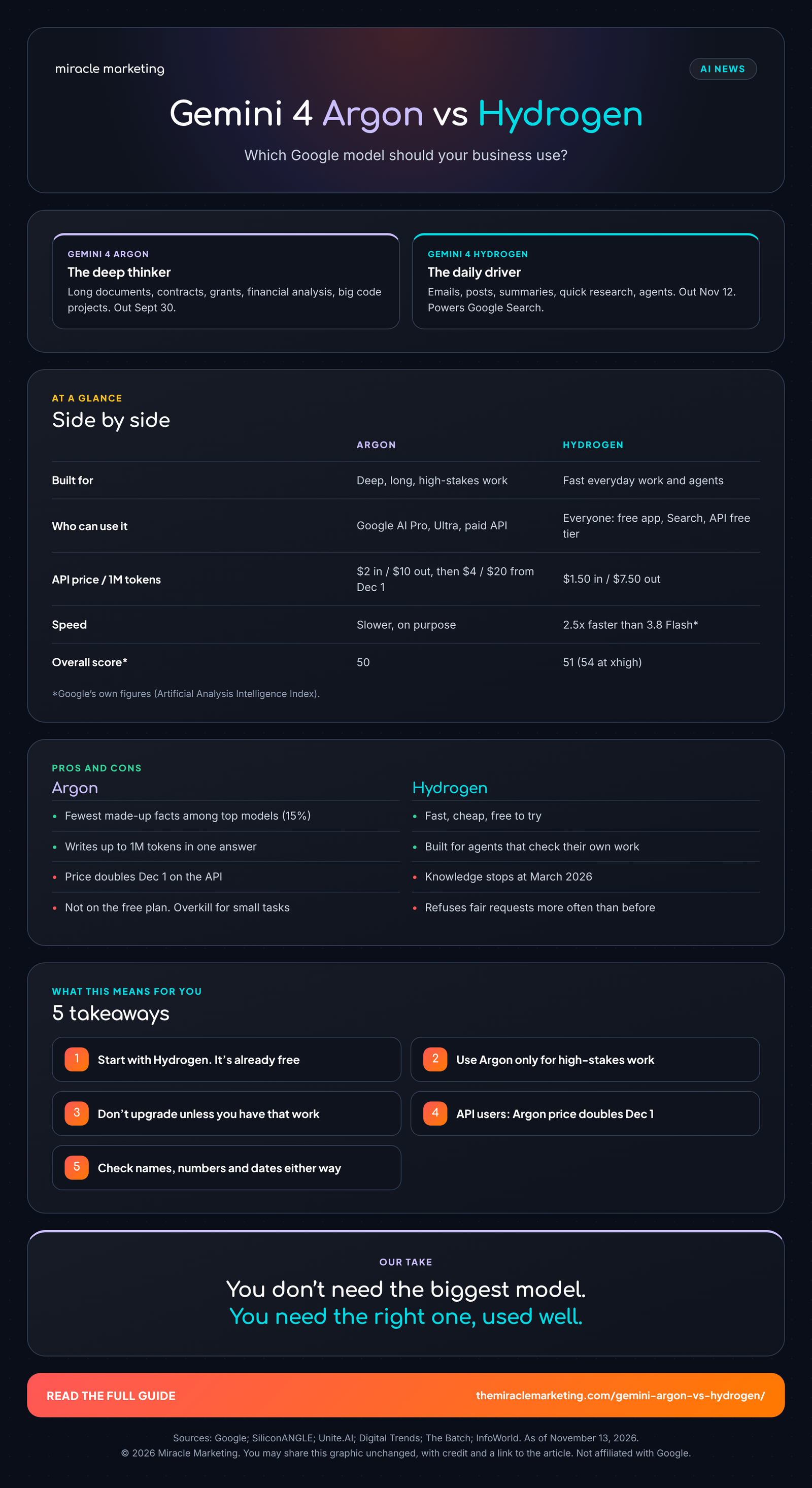
Argon vs Hydrogen at a glance
| Gemini 4 Argon | Gemini 4 Hydrogen | |
|---|---|---|
| Built for | Deep, long, high-stakes work | Fast everyday work and AI agents |
| Released | Sept 30 (limited); Oct 13 (wider) | Nov 12, available to everyone |
| Who can use it | Google AI Pro and Ultra, paid API | Free app (automatic), Search, paid plans, API with a free tier |
| API price (per million tokens) | $2 in / $10 out until Nov 30, then $4 / $20 | $1.50 in / $7.50 out |
| Speed | Slower; takes its time on purpose | 2.5x faster than Gemini 3.8 Flash (Google) |
| Overall score (Artificial Analysis, Google's figures) | 50 | 51 at default; 54 at xhigh |
| Context window | 1M tokens in, up to 1M out | 1M tokens shared by input, thinking and output |
Argon: pros and cons
Pros
- Strong on careful, factual work. Low hallucination scores matter when you're reading a contract or a budget.
- Can produce very long outputs, such as a full manual or a large code change, in one go.
- Good at multi-step tool use. One analyst called it strong at "factual grounding."
- Google says it's its most resistant model to prompt injection, where hidden text in a web page or file tries to hijack the AI.
Cons
- Costs twice as much after November 30. Over the API, $4 in and $20 out is more than double Hydrogen's price.
- Not on the free plan, and not included in most Google Workspace business editions without an add-on.
- Slower. It's overkill for an email, a social post or a quick question.
- Reviewers rated it average at everyday coding and weaker at creative writing and plain-English explanations.
Hydrogen: pros and cons
Pros
- Fast and cheap, which matters if you run many small tasks or build AI into your own tools.
- Free to try. You may already be using it without knowing.
- Built for agents that write, test and check their own work, with fewer cases of the AI going beyond what you asked.
- On Google's figures it matches or slightly beats Argon on overall scores at a lower price.
Cons
- Its knowledge stops at March 2026, so ask it to search for anything recent.
- Google's own model card says it refuses legitimate requests more often than the model it replaced.
- The highest thinking level, xhigh, burns more tokens and can "overthink simpler prompts," in Google's own words.
- On command-line coding tests it scored 57%, behind Claude Sonnet 5.5 at 63.9%.
Which one should you use?
Pick by the job, not by the name.
- Use Hydrogen for: emails, posts, newsletters, meeting notes, quick research, summaries, spreadsheet help, customer replies, and any automated workflow that runs many times a day.
- Use Argon for: reviewing a long contract or policy, a grant application, a financial or competitor analysis, a large code project, or any task where one wrong fact costs real money.
- Building with the API? Start on Hydrogen. Send only the hard tasks to Argon or Carbon. Google's coding tool, Antigravity, already does this: one model plans, Hydrogen does the work. Google reports this used about 24% less quota.
What this means for you
- You don't need to upgrade to get the new model. If you use Google Search or the free Gemini app, Hydrogen is already working for you.
- Pay for Argon only if you have the work for it. If you rarely deal with long documents or complex analysis, AI Pro or Ultra won't pay for itself.
- Mark November 30. If you or your developer use Argon through the API, the price doubles that day. Check your usage now.
- Check the facts either way. Fewer made-up facts doesn't mean none. Before you publish or send anything with names, numbers, dates or quotes, check them.
- Watch your search traffic. Hydrogen now powers Search, so AI answers will keep getting faster and longer. Your website and Google Business Profile need to give clear, current answers the AI can pick up.
Our take
Most people don't need the biggest model. They need the right one, used consistently. For nine out of ten tasks a small business or nonprofit does each week, Hydrogen is enough, and the price and speed make it the sensible default.
Argon has a place: the contract you're about to sign, the grant you can't afford to lose, the report your board will question. Use it for that and stop there.
A word of caution. Nearly every number in this comparison comes from Google, and independent tests already disagree in places. One independent ranking put Argon higher than Google's chart does. Treat benchmarks as a starting point, then test both models on your own work for a week. Your results will tell you more than any leaderboard.
Not sure which AI tools fit your team, or how to set them up without wasting money? Book a free strategy call and we'll map it out with you.
Facts as of November 13, 2026. Prices and availability change often; check Google's pages before you buy. Miracle Marketing is not affiliated with Google.
Sources
- Google: Gemini 4 Argon announcement (Sept 30, 2026)
- SiliconANGLE: Google releases Gemini 4 Hydrogen
- Unite.AI: Gemini 4 Hydrogen for everyday agentic workflows
- Digital Trends: Gemini 4 Hydrogen availability
- The Batch: Argon, a low-hallucination model for knowledge work
- InfoWorld: Google makes Gemini 4 available to a trusted few
- Digital Applied: Who can use Gemini 4 Argon
- VentureBeat: Gemini 4 Carbon now publicly available
Keep reading
Book a strategy call. We will look at how customers reach you today and tell you honestly where to start.
© 2026 Miracle Marketing. This article and its graphics are protected by copyright, so please do not copy them without permission. You may share a graphic unchanged, with credit and a link to the article.