
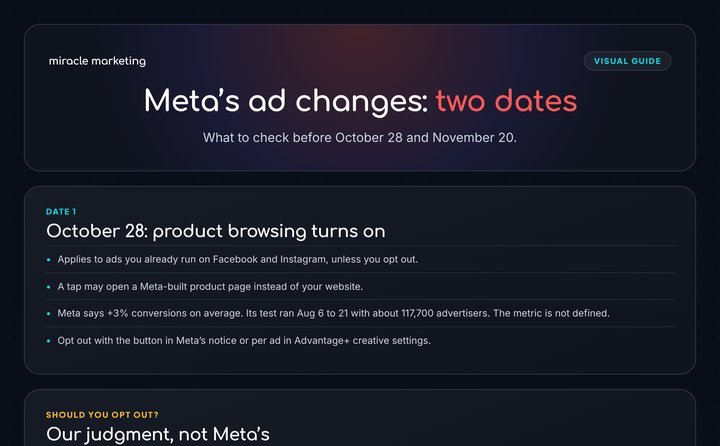
Meta is changing two things for anyone who advertises on Facebook and Instagram. One happens on October 28. The other, which was set for October 30, has been pushed to November 20. Neither needs a panic, but one needs a decision from you before tomorrow ends.
Change 1: Product browsing turns on October 28
Meta told advertisers it will switch on "product browsing" for ads you already run, unless you opt out. When someone taps one of these ads, they may see a Meta-built product page inside the app, built from your product catalog, instead of landing on your website. Shoppers can still continue to your site, but Meta's page comes first. Per PPC Land, which reproduced Meta's notice:
- Meta says product browsing lifted conversions by 3% on average. That comes from a test run August 6 to 21 across about 117,700 advertisers, mostly e-commerce, consumer goods and retail. The notice does not define the metric or how the comparison was made.
- You can opt out with the button in Meta's notice, or per ad in the Advantage+ creative settings. The per-ad setting can be changed after October 28 too.
- The notice does not say whether new ads will default to it, or whether it applies to ads without a product catalog.
This change is separate from the terms update and is not reported as delayed.
Should you opt out?
This is our judgment, not Meta's advice:
- Opt out if your website does the work. Lead forms, booking pages, donation pages, event sign-ups and quote requests all depend on people landing on your page. A Meta product page in between adds a step you do not control.
- Test it if you sell catalog products. Run one ad set with it on and a matching one with it off for 7 to 10 days, and judge by your own sales records, not only Ads Manager. Some advertisers report that Ads Manager may not separate in-app browsing from site visits.
Change 2: New ad terms moved to November 20
Meta's updated Commercial Terms and Self-Serve Ad Terms were due October 30. After complaints from publishers and advertisers, Meta moved them to November 20, reported by Reuters. A Meta spokesperson said the extra time is to explain what is changing. Meta has not said it will rewrite the terms. What the current text says, per The Register and a law-firm client alert from Shumaker, Loop & Kendrick:
- Crawling. Meta may use automated tools to crawl websites "associated with" your business. That term is not defined. After the backlash, the sentence about training AI on that content was removed, and the stated purpose is now "advertising and business products." The terms do not commit Meta to honor your robots.txt file, although a Meta spokesperson has said you can use it to signal preferences.
- AI responsibility. You are solely responsible for what Meta's AI features produce, including ad content they write or change. You must also indemnify Meta against claims arising from AI-powered business agents.
- Acceptance. Continuing to use Meta for business counts as accepting. There is no partial consent. The alternative is to stop commercial use.
- Arbitration. US businesses have 30 days from first acceptance to opt out of arbitration. If you accept on November 20, that window would close around December 20.
It applies to anyone using Ads Manager or Meta Business Suite, or managing a Page. That includes churches, schools and nonprofits, not only advertisers with big budgets. We could not open Meta's own terms pages, so confirm details there.
6 things to do this week
- Decide on product browsing today. Find Meta's notice in Ads Manager and opt out, or note the date you will test it.
- Check each ad. Open Advantage+ creative settings on your active ads and confirm product browsing is off where you want it. Check duplicated ads too.
- List every Meta account and Page you or an agency manage, and who has admin access.
- Ask your agency in writing who reviews AI-written ad copy before it runs, and who accepts Meta's terms for your accounts.
- Look at what your site shows publicly. Gate private pages behind a real login. Robots.txt is a request, not a lock.
- Save a dated copy of the terms and put November 20 on your calendar. Have a lawyer read the AI liability and arbitration parts. We are not lawyers, and this is not legal advice.
Our take
Meta can change how your ads work, and what you agree to, by sending a notice. Silence counts as yes. That is legal and common, and it is also why a business that depends on one platform should read the notices, not just the dashboards.
The delay is not a reversal. The crawling, AI responsibility and acceptance language is largely the same, so use the extra weeks. Do the checks above, ask your agency the questions, and keep your own website and email list strong so no single platform's terms can hold your marketing hostage.
We manage Meta and Google ads for clients, so these changes affect our work too. Information here is as of October 27, 2026 and may change.
Sources
- PPC Land, product browsing notice
- PPC Land, terms delayed to November 20
- PPC Land, what did and did not change
- The Register, Meta and website crawling
- Shumaker, Loop & Kendrick client alert
Keep reading

Book a strategy call. We will look at how customers reach you today and tell you honestly where to start.
© 2026 Miracle Marketing. This article and its graphics are protected by copyright, so please do not copy them without permission. You may share a graphic unchanged, with credit and a link to the article.