
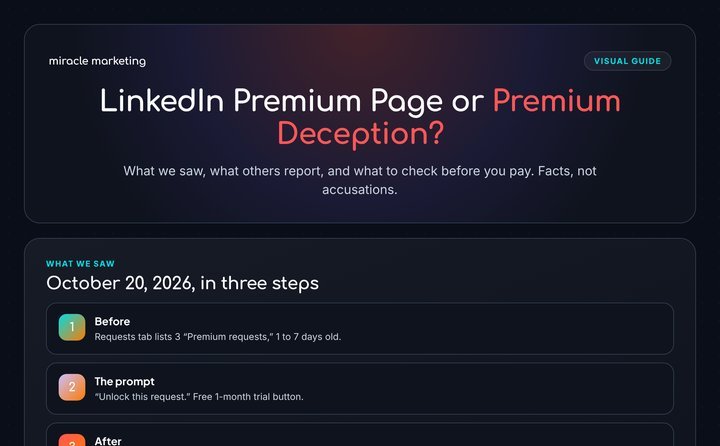
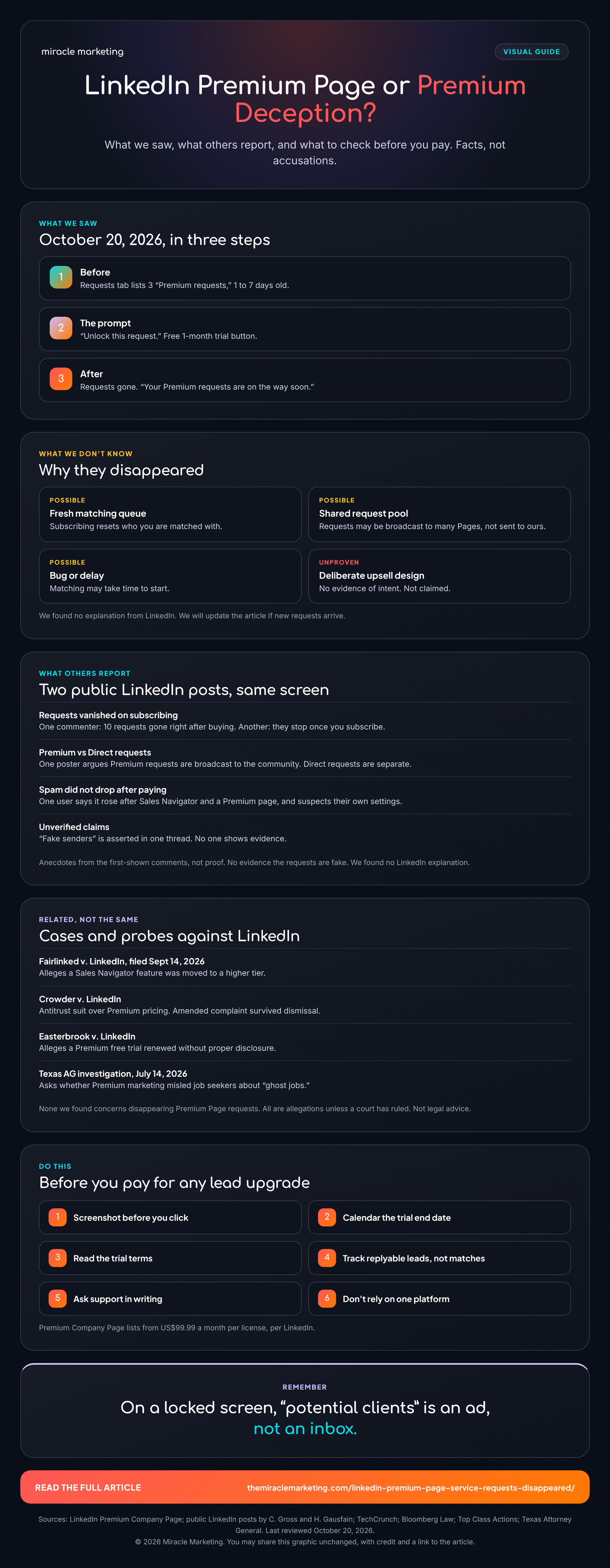
On October 20, 2026, the Services tab of our LinkedIn Page listed three "Premium requests" from people looking for business consulting. They were dated 1, 4 and 7 days old. We tapped "Try Premium Page for $0." Our later screenshot, taken at 8:15 by our phone's clock against 7:41 for the first, shows all three gone and the message: "Your Premium requests are on the way soon."
We have screenshots of both states. We do not know why it happened. This post covers what we saw, what LinkedIn says Premium Page includes, which lawsuits exist and what they do and do not cover, and what to check before you pay for any lead-generation upgrade.
What we saw, in order
- Before the trial: The Requests tab showed a "Premium requests" section with three entries, each tagged Business Consulting, with the requester's name and headline visible.
- The prompt: Opening one request showed project details, but a banner above them read "Unlock this request and get up to 30 more potential clients each month," with a "Try Premium Page for $0" button and "1-month free. Easy to cancel. No penalties or fees."
- After starting the trial: The three requests no longer appeared. An empty-state graphic with a sample "$500 budget" card replaced them, with the message that matches were "on the way soon."
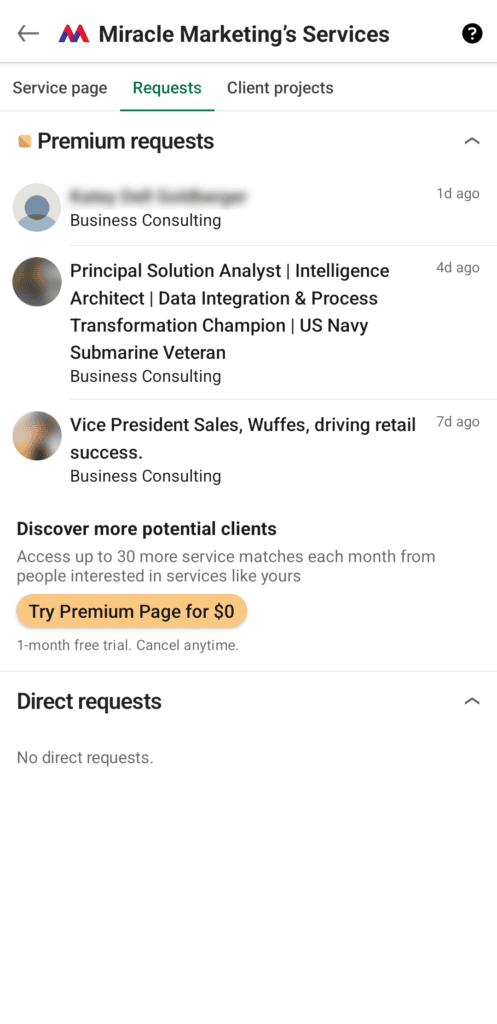
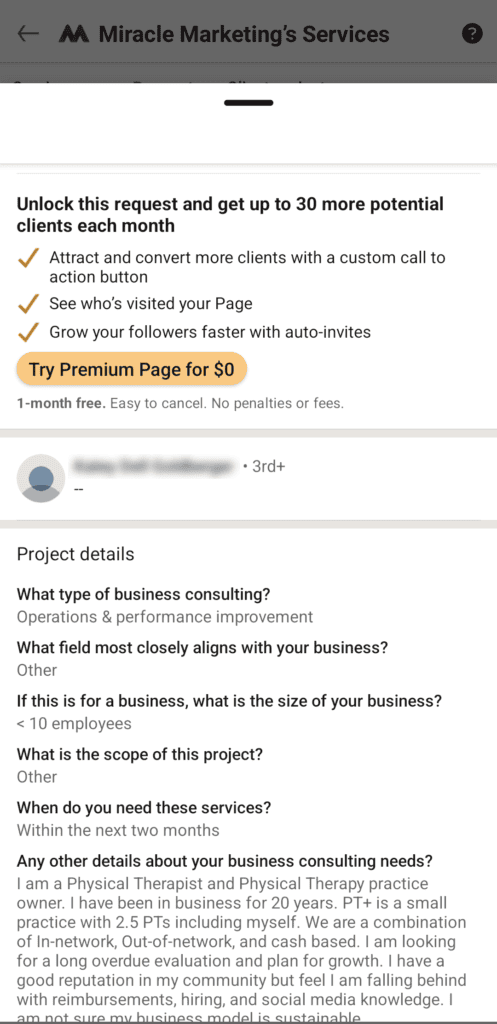
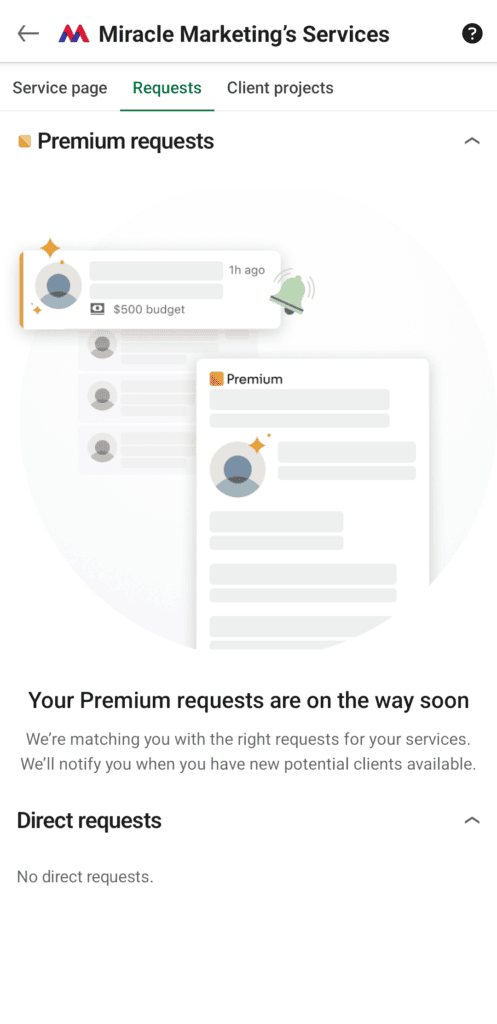
We redacted the requesters' names, photos and project details because they are private individuals.
What LinkedIn says Premium Page includes
According to LinkedIn's Premium Company Page page, the subscription includes up to 30 extra "service matches" each month from people searching for services like yours, a custom call-to-action button, page-visitor insights, auto-invites to follow your Page, a verification option, and competitor insights. Listed pricing starts at US$99.99 a month, or US$839.88 a year, per license, before taxes. TechCrunch reported LinkedIn began testing the product in April 2024.
Nothing on that page says that requests you can already see will remain visible, or will disappear, when you subscribe. That gap is the issue.
What we don't know
Several explanations fit what we saw, and we cannot tell them apart:
- A fresh matching queue. Starting Premium may reset how requests are matched, so earlier previews drop out until new ones arrive.
- Preview requests were never ours to keep. They may have been broadcast requests drawn from a shared pool rather than messages sent to us (see below).
- A bug or delay. The "on the way soon" message suggests matching takes time.
- A deliberate upsell design. We have no evidence of intent, and we are not claiming it.
We found no explanation from LinkedIn, and we have not contacted its support. We will update this post with whether new requests arrived during the trial.
We are not the first to notice
Two public LinkedIn posts, each months old, describe the same screen.
- M&A advisor Chad Gross argues "Premium requests" are not clients contacting you; those appear under "Direct requests." He says Premium requests look sent to the wider community, and he could not verify the one he checked.
- Content designer Hana Gausfain describes a run of Premium requests after years of none, with an activation prompt attached. Commenters in her thread say requests vanished after they subscribed: one reports ten disappearing right after purchase, another that they stopped arriving.
What commenters in those threads report (paraphrased, names omitted):
- One person says ten requests vanished right after they bought Premium through Google Play, and the app then pushed more paid extras.
- Another says requests stop arriving once you subscribe.
- One says they received about six such requests in a week after setting up a services page, and asked how to turn them off.
- One checked a sender and got confused replies when asking for project details.
- One says spam rose, not fell, after paying for Sales Navigator and a Premium business page, and suspects their own profile settings contributed.
- Several call it deceptive or a dark pattern. That is opinion.
We read only the comments LinkedIn showed first, a fraction of each thread, and people who had a good experience are less likely to comment under a post titled "scam." These are consistent anecdotes, not proof. The author of the second post calls the requests fake and the senders fake users; nobody shows evidence of that, and we have not seen any. What the reports support is narrower: more than one person saw requests disappear when they subscribed. Our own "Direct requests" section was empty the whole time, while the three requests sat under "Premium requests."
The lawsuits: what exists and what doesn't
Searching for this behavior turns up several lawsuits against LinkedIn, but none we found concerns Premium Page requests disappearing. Do not read them as proof of what happened to us. They show scrutiny of how LinkedIn sells paid tiers:
- Fairlinked e.V. v. LinkedIn (N.D. Cal., filed September 14, 2026): alleges LinkedIn moved a Sales Navigator feature to a higher tier, forcing customers to upgrade, per Bloomberg Law. Unproven.
- Crowder v. LinkedIn (N.D. Cal.): an antitrust suit alleging Premium subscribers were overcharged. A judge declined to dismiss the amended complaint, as reported in April 2024. Ongoing as of that report.
- Easterbrook v. LinkedIn (D. Or.): alleges a Premium free trial renewed without proper disclosure, filed in 2022. We could not confirm its current status.
- Advertiser suit: LinkedIn agreed to a $6.625 million preliminary settlement in 2024 over allegedly inflated video ad views, without admitting wrongdoing.
- Texas Attorney General: on July 14, 2026, opened an investigation into whether LinkedIn misled Premium subscribers about "ghost jobs." No findings reported.
Every claim above is an allegation unless a court has ruled. This is not legal advice.
Before you pay for any lead upgrade: 6 checks
- Screenshot first. Capture what is visible before you click, with the date and time showing.
- Set a cancel reminder now. Free trials of paid tiers renew into the listed price unless you cancel. Put the trial's last day on your calendar.
- Read the trial terms on the checkout screen, not just the button.
- Track one number: leads you can actually reply to, not "matches." If the trial produces none, you have your answer.
- Ask support in writing what happens to existing requests after you subscribe. Keep the reply.
- Don't depend on one platform for leads. A rented audience can change its rules overnight. Your own site, listings and email list do not.
Our take
Showing a business real-looking demand and then putting a paywall in front of it is a legitimate sales tactic. It stops being fair if the demand disappears when you pay. We can't say which of those happened here, and anyone who claims certainty after one afternoon is guessing. What we can say: LinkedIn should state plainly, at the point of purchase, whether the requests you can see are the ones you will get.
Here is our opinion, and it is only that. Tactics like this cost LinkedIn something it cannot easily buy back: professionals' belief that what the platform shows them is real. A consultant who feels baited once will discount every notification afterward, including the genuine ones, and will stop treating LinkedIn as a source of leads. We expect owners to drift toward channels they control: their own site, referrals, email lists and direct outreach, with LinkedIn demoted to a profile and a place to post. We would not bet on professionals leaving altogether. LinkedIn's network is still the largest of its kind, and many will stay out of habit. But trust lost this way rarely comes back quickly, and the people who notice first are exactly the independent professionals LinkedIn most wants to sell to.
Until LinkedIn explains, treat "potential clients" on any locked screen as an advertisement, not an inbox.
Update, October 20, 2026: article published during an active trial. We will add what LinkedIn tells us and whether any requests arrived.
Keep reading
Book a strategy call. We will look at how customers reach you today and tell you honestly where to start.
© 2026 Miracle Marketing. This article and its graphics are protected by copyright, so please do not copy them without permission. You may share a graphic unchanged, with credit and a link to the article.