
Say you run a salon and you put a card on the counter: "Leave us a five-star review and get 10% off your next visit." It feels harmless.
It is also the one version of review rewards that the Federal Trade Commission (FTC) names specifically as a violation. And if the review goes on Google, Google's own policy says any reward for a review is out.
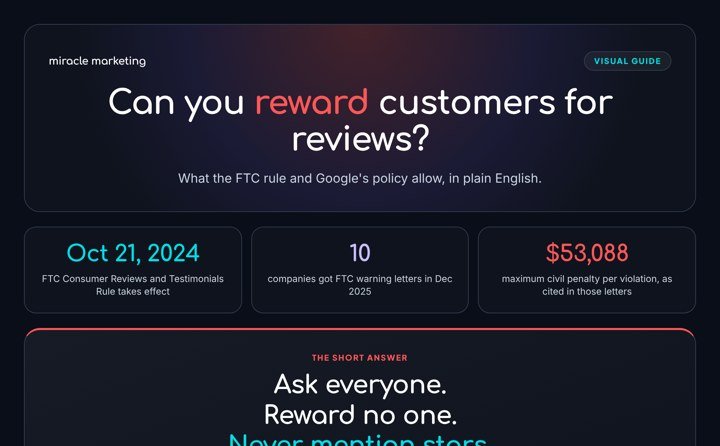
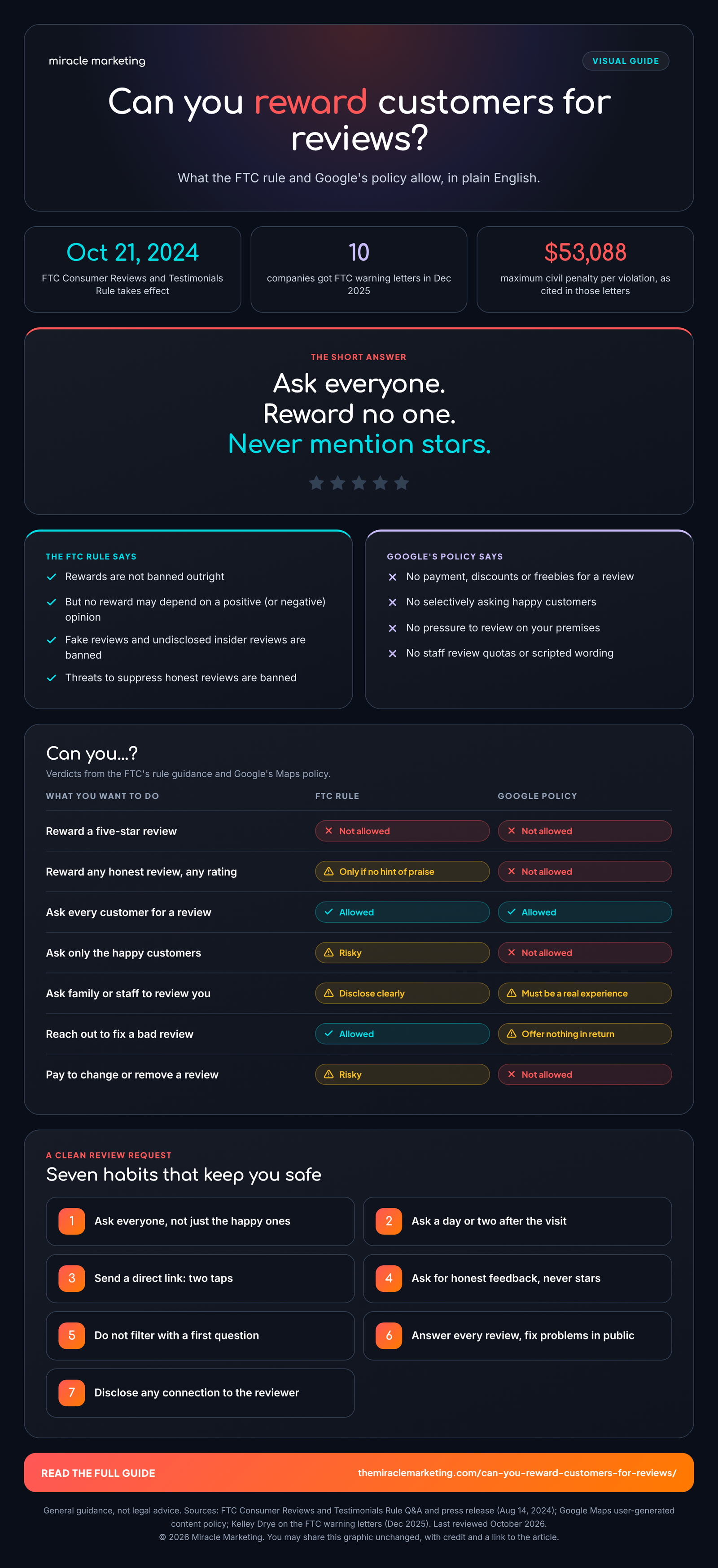
The short answer: two rulebooks apply, and they are not the same. The FTC lets you reward a review in some cases, but never in exchange for a positive one. Google flatly bans incentives for reviews. The safest system is to ask every customer for an honest review, give nothing in return, and never mention stars.
Many top-ranking guides come from review-software vendors. Here is what the rules themselves say.
What the FTC rule says
Since October 21, 2024, a federal rule on consumer reviews and testimonials has been in force, and a one-person shop is covered the same as a national chain. Here is what it prohibits:
- fake reviews and testimonials, whether you write them, buy them or sell them, and that includes ones made by AI
- handing a customer a reward for a review when the reward is tied to what the review says, spoken or implied
- reviews by owners, managers, staff or their family that hide the relationship
- passing off a website you run yourself as a neutral third-party review site
- scaring people out of honest reviews, or getting them taken down, with intimidation or empty legal threats
- paying for fake followers, views or similar social media numbers, or selling them
Two points from the FTC's own Q&A matter most. Incentives are not banned outright; they are a problem when a positive review is required or implied. And asking only customers you think are happy is not named in the rule, but the FTC says it could still break the FTC Act.
The penalties are real. In December 2025 the FTC sent warning letters to ten companies, citing civil penalties of up to $53,088 per violation. It has not said any of them broke the rule.
What Google's policy says
Google's rules for Maps reviews are stricter than the FTC's. According to its policy, a business may not:
- give money, coupons or freebies for a review, for editing one, or for deleting a bad one
- selectively ask only the customers likely to leave positive reviews
- discourage or prohibit negative reviews
- pressure customers to rate or review while they are still on your premises
- require staff to collect a set number of reviews or ask for specific wording, including a staff member's name
Encouraging genuine reviews is fine. Just attach no perk, and do not steer the rating or the wording.
What you can and cannot do
Reward a five-star review
- FTC: Not allowed
- Google: Not allowed
Reward any honest review, whatever the rating
- FTC: Allowed if nothing hints at a positive opinion
- Google: Not allowed
Ask every customer for a review
- FTC: Allowed
- Google: Allowed
Ask only the happy customers
- FTC: Risky: may break the FTC Act
- Google: Not allowed
Ask family or staff to review you
- FTC: Only with a clear, visible disclosure
- Google: Reviews must reflect a real experience
Contact an unhappy reviewer to fix the problem
- FTC: Allowed
- Google: Allowed, but offer nothing to remove the review
Pay to change or remove a negative review
- FTC: Risky: may be unfair or deceptive
- Google: Not allowed
The FTC does not ban rewards for any honest review. But Google bans them, and most local reviews live on Google, so for most small businesses the practical answer is no.
A review request that works and stays clean
- Ask everyone. Same message to every customer.
- Ask soon. Within a day or two, while the visit is still vivid.
- Make it two taps. Send the direct link to your review page.
- Ask for honesty, not stars. "We would value your honest feedback" is fine. "Tell us how much you loved it" nudges toward praise.
- Do not filter. Never screen with "how was it?" and route only the pleased customers to your review page.
- Answer every review. Thank people and fix problems in public.
- Disclose connections. If a relative or employee posts, say so.
Want to thank customers? Thank all of them, review or not. That is hospitality. A perk that hinges on a review is what these rules target. Unsure? Ask a lawyer first.
Common questions
Can I give a discount for a review? The FTC rule can permit it if the perk never depends on a positive opinion. Google prohibits it, and incentivized reviews may be taken down.
What happens if I break the rules? You risk the FTC's civil penalties, and Google removes reviews posted for an incentive. Reviews that look bought also hurt the trust you were trying to build.
Is this legal advice? No. The FTC says its staff guidance is not definitive or comprehensive. If you plan a review program, have a lawyer read it first.
Where to go next
Reviews are one part of how customers choose you. See how fast, friendly follow-up fits in on our lead generation and follow-up page, or book a strategy call and we will look at how customers find and reach you today.
Sources
- Federal Trade Commission, Consumer Reviews and Testimonials Rule: Questions and Answers.
- Federal Trade Commission, Federal Trade Commission announces final rule banning fake reviews and testimonials, August 14, 2024.
- Google, Maps user-generated content policy.
- Kelley Drye, FTC warns companies of potential violations of the Consumer Review Rule, December 2025.
Last reviewed October 2026. Rules change, so check the FTC and Google pages above before you act.
Keep reading
Book a strategy call. We will look at how customers reach you today and tell you honestly where to start.
© 2026 Miracle Marketing. This article and its graphics are protected by copyright, so please do not copy them without permission. You may share a graphic unchanged, with credit and a link to the article.