
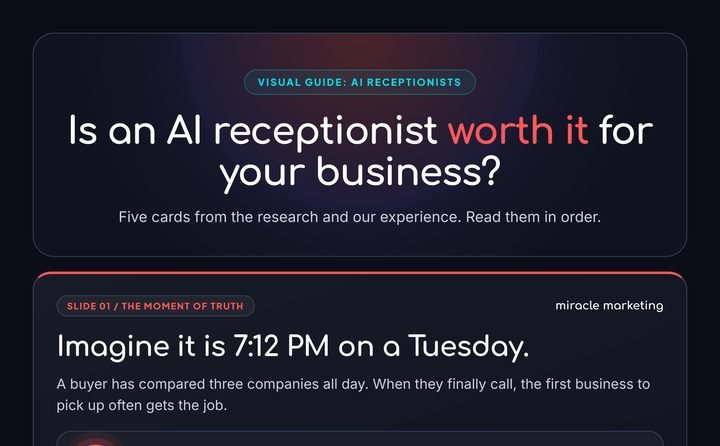
Imagine it is 7:12 on a Tuesday evening. A customer who has been comparing three companies all day finally decides to call. The first company to pick up usually gets the job. Your phone rings, nobody is at the desk, and it goes to voicemail. A minute later they are calling your competitor.
That gap is what an AI receptionist is built to close. But is it worth it? Short answer: it can be, if missed calls and slow replies are costing you customers, and your team keeps answering the same questions every day. It is probably not worth it if you already answer every call, or if most of your calls are complicated or sensitive.
What is an AI receptionist?
An AI receptionist is an AI assistant that answers calls, texts and website chats for a business. It answers common questions, collects the details of new inquiries, books appointments into your calendar and hands anything it should not handle to a person.
It is different from a basic chatbot, which follows a fixed script, and from a traditional answering service, which mostly takes messages. We call ours Miracle, and you can see how it works on our AI receptionist page.
Why reply speed matters
People rarely wait for a callback. Research published in Harvard Business Review found that most companies are not responding to online inquiries nearly fast enough. A later study by InsideSales.com compared what sales professionals believed with what their companies actually did. Nearly a quarter said they responded to online leads by phone within five minutes, but only about 5 percent really did.
Both studies are over ten years old, and the second came from a software vendor, so read them as a pattern, not a forecast. Businesses tend to think they reply faster than they do.
When an AI receptionist is worth it
- You miss calls after hours, at lunch or while you are on a job.
- Inquiries arrive through several channels, such as calls, texts and website chat, and some wait too long for a reply.
- Your team answers the same handful of questions all day.
- Bookings are lost between the first inquiry and the calendar.
- You want a first reply to go out right away, even when everyone is busy.
When it is not
- You already answer almost every call and reply within minutes.
- Most of your calls are urgent, emotional or highly complicated, and need a person from the first word.
- Your answers change constantly and nobody can keep the information up to date.
- You are not willing to review real conversations in the first weeks and fix what it gets wrong.
AI receptionist, human receptionist or answering service?
Hours
- Human receptionist: Set shifts, breaks and time off
- Answering service: Depends on the plan
- AI receptionist: Always on
Many callers at once
- Human receptionist: One at a time
- Answering service: Depends on staffing
- AI receptionist: Yes
Answers questions
- Human receptionist: Yes, once trained
- Answering service: Usually takes a message
- AI receptionist: Yes, from the information you give it
Books appointments
- Human receptionist: Yes
- Answering service: Sometimes
- AI receptionist: Yes, into your calendar
Sensitive or complex calls
- Human receptionist: The best option
- Answering service: Passes on a message
- AI receptionist: Hands off to a person
How you pay
- Human receptionist: Salary and benefits
- Answering service: A monthly or per-minute fee
- AI receptionist: A monthly plan
What a good AI receptionist should never do
- Pretend to be a person. It should tell callers it is an AI assistant, and make it easy to reach a human.
- Contact people without consent. In 2024 the FCC ruled that AI-generated voices count as artificial voices under the TCPA, so calls that use them generally need the person's prior consent. This is general information, not legal advice.
- Guess. If it does not know, it should say so and pass the conversation to your team.
- Handle emergencies. Urgent or sensitive requests belong with a person.
A real example
Als Tire and Auto Center in Springfield, VA was losing calls and foot traffic to competitors because nobody at the shop could answer the phone. We set up an AI receptionist on the website that works around the clock and engages visitors. We also connected SMS, Facebook messages and web forms into one unified inbox, so every inquiry lands in a single place.
How to start without overcomplicating it
- For one week, write down every call and message that goes unanswered or waits more than a few hours.
- Pick the single gap that hurts most. For many businesses it is after-hours calls or slow website chat.
- List the ten questions customers ask most, with your real answers.
- Test it yourself before it speaks to a customer. Call it, try to confuse it and ask for a person.
- Review real conversations in the first weeks and fix what it gets wrong.
Common questions
Does an AI receptionist replace my staff? No. It takes over the repetitive first reply and the booking, so your team can spend its time on conversations that need a person.
Will customers mind talking to an AI? Most people want a quick, correct answer. Tell them it is an AI and make it easy to reach a person.
Is it expensive? Pricing depends on the size of your business and how much you want it to handle. We share exact pricing on a strategy call.
Where to go next
If missed calls are costing you customers, see how our AI receptionist works, or read about lead generation and instant follow-up. When you are ready, book a strategy call.
Sources
- James B. Oldroyd, Kristina McElheran and David Elkington, The Short Life of Online Sales Leads, Harvard Business Review, 2011.
- MarketingProfs, Companies unaware of slow sales response times, summarizing an InsideSales.com study, 2013.
- Mayer Brown, FCC declares authority and intent to regulate AI-generated calls under the TCPA, 2024.
Keep reading
Book a strategy call. We will look at how customers reach you today and tell you honestly where to start.
© 2026 Miracle Marketing. This article and its graphics are protected by copyright, so please do not copy them without permission. You may share a graphic unchanged, with credit and a link to the article.