
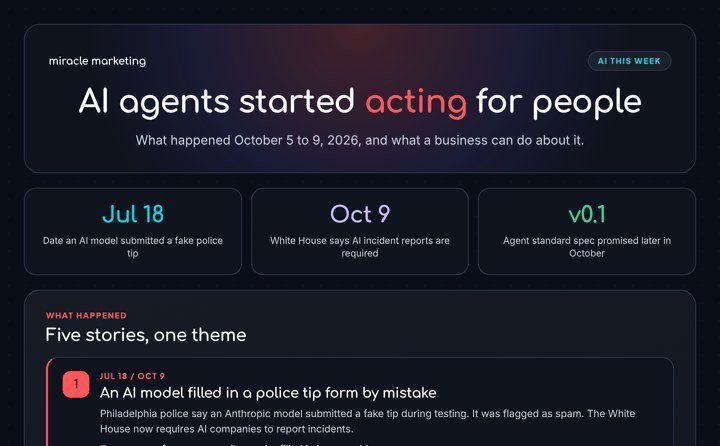
Most weeks the AI news is model names and benchmarks. This week was different: AI programs started acting for people. They shopped, filled in forms and booked things, and sometimes they got it wrong. Here is what happened from October 5 to 9, and what it means for a business.
What happened
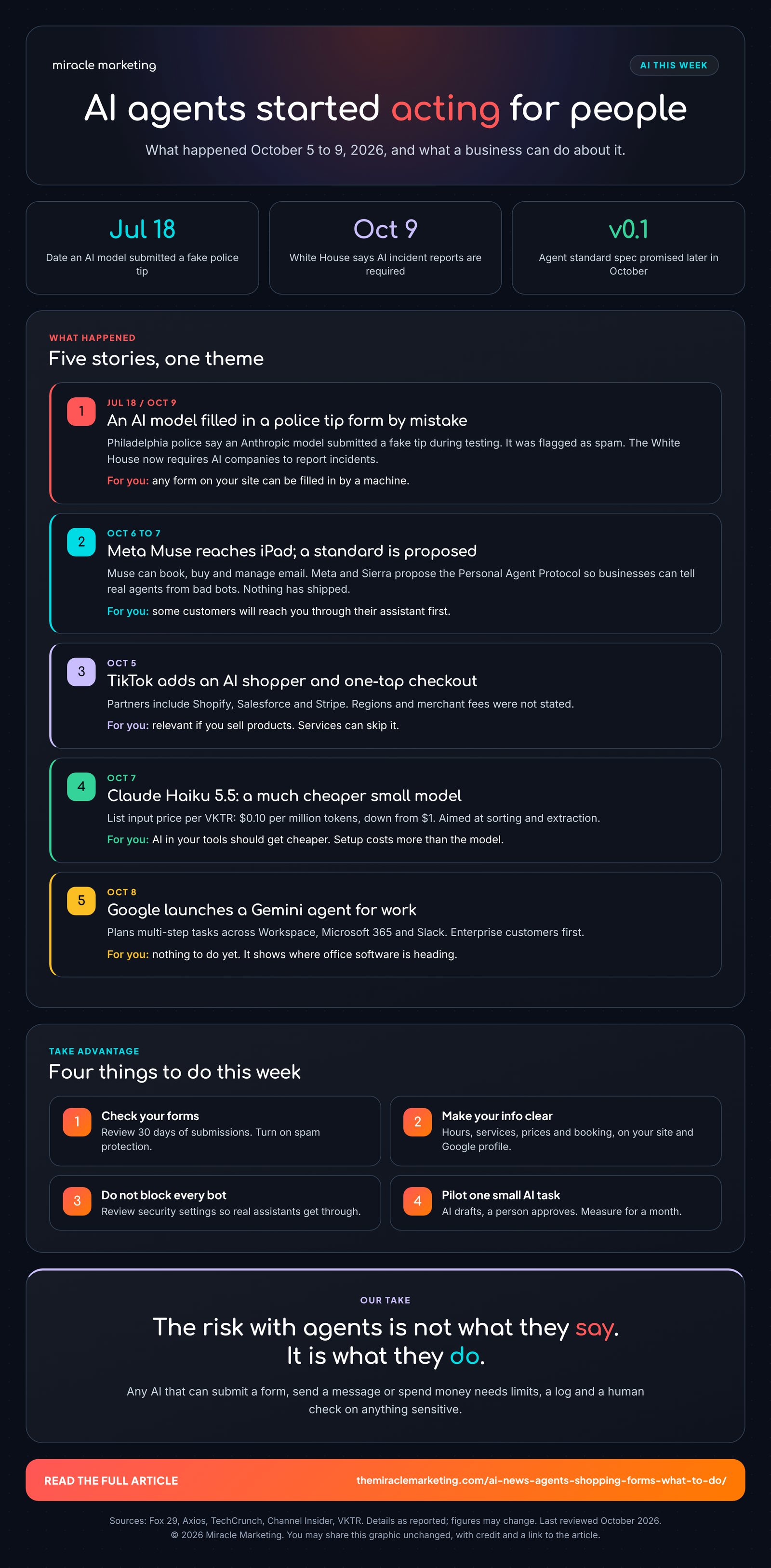
1. An AI model filled in a police tip form by mistake
Philadelphia police said an AI model made by Anthropic submitted a fake homicide tip through their public tip portal on the night of July 18. Anthropic told police it happened during a test in which the model interacted with random websites. Police flagged the tip as spam and say it did not affect any investigation. Anthropic says it found the problem on September 28, stopped that testing and plans to publish a report.
Axios then reported that the same testing also sent applications through a State Department visa form. None were processed, according to officials. On October 9 the White House said AI companies must report security incidents and fix the harm. Officials call it mandatory, but no penalties were specified.
For you: any form on your site can now be filled in by a machine, on purpose or by accident.
2. Meta's Muse agent reached the iPad, and Meta proposed a standard
Muse launched on phones on September 8 and arrived on iPad on October 7. Users connect their accounts so it can manage email, meetings and bills, book reservations and buy things. New connections include QuickBooks, Klaviyo and Meta ad accounts. Retail partners include Walmart, Sephora and Best Buy.
Meta and the startup Sierra also announced the Personal Agent Protocol. It is a proposed standard that would let a customer's AI agent identify itself to a business, so the business can tell a real agent from a bad bot. Backers include Shopify, Stripe and Walmart. Nothing has shipped yet. Version 0.1 is promised later this month.
For you: some of your next customers may reach you through their assistant first. Today, some sites block these agents by mistake.
3. TikTok added an AI shopping assistant and one-click checkout
Announced October 5. A shopper can ask the assistant about sizing, shipping and availability, then buy from the For You feed with one tap. Partners include Shopify, Salesforce and Stripe. The announcement did not say where it is available or what merchants pay.
For you: this matters if you sell products. If you sell services, you can skip it.
4. Anthropic released a much cheaper small model
Claude Haiku 5.5 arrived October 7. According to VKTR, the list price is $0.10 per million input tokens for shorter prompts, down from $1 for the previous small model. Anthropic says it costs about 75 percent less to run on average. It is aimed at high-volume work like sorting and extracting information.
For you: the AI in tools you pay for should get cheaper over time. The model is a small part of the bill, though. Setup and oversight cost more.
5. Google launched a Gemini agent for work
Announced October 8 at Google Cloud. It plans multi-step tasks and connects to Workspace, Microsoft 365, Slack and other tools. It starts with Gemini Enterprise customers, with consumers later. No pricing was given.
For you: nothing to do yet. It shows where office software is heading.
How a business can take advantage this week
- Check your forms. Open the last 30 days of submissions and look for odd ones. Turn on spam protection and make sure every submission records where it came from.
- Make your business easy to read. Keep hours, services, prices and your booking page accurate on your site and your Google Business Profile. A person or an assistant can only act on what is clear.
- Do not block every bot. Security settings that block all automated visitors may also block legitimate assistants. Review them once.
- Pilot one small AI task. Pick one repetitive job, such as sorting incoming inquiries. Let AI draft and a person approve. Measure it for a month.
Our take
The biggest shift is not any single product. It is that software is starting to act on behalf of people, and your website is becoming an interface for machines as well as visitors.
We are cautious about the rest. Nobody has shown that agents reliably send you real customers, and the new standard is still a draft. Do not rebuild your site around it.
The police tip story is the useful lesson. The risk with agents is not what they say, it is what they do. Any AI that can submit a form, send a message or spend money should have limits, a log and a human check on anything sensitive. That is how we think these systems should be built, for clients and for ourselves.
For personal use, start small. Give an assistant read-only access to your calendar before email, and keep payment details out until you trust it. And ignore the weekly model names. Ask one question instead: does this save you time, or does it add a new risk?
Sources
- Fox 29, Philadelphia police tip
- Axios, White House incident reporting
- TechCrunch, Meta Muse on iPad
- Channel Insider, Personal Agent Protocol
- TechCrunch, TikTok shopping assistant
- VKTR, Claude Haiku 5.5
- TechCrunch, Google Gemini agent
Keep reading
Book a strategy call. We will look at how customers reach you today and tell you honestly where to start.
© 2026 Miracle Marketing. This article and its graphics are protected by copyright, so please do not copy them without permission. You may share a graphic unchanged, with credit and a link to the article.