
If your website traffic dipped this year, someone has probably told you it is "AI." Sometimes that is true. Often it is not. The honest answer depends on what people search for to find you, and you can check it yourself in about an hour.
What the research says so far
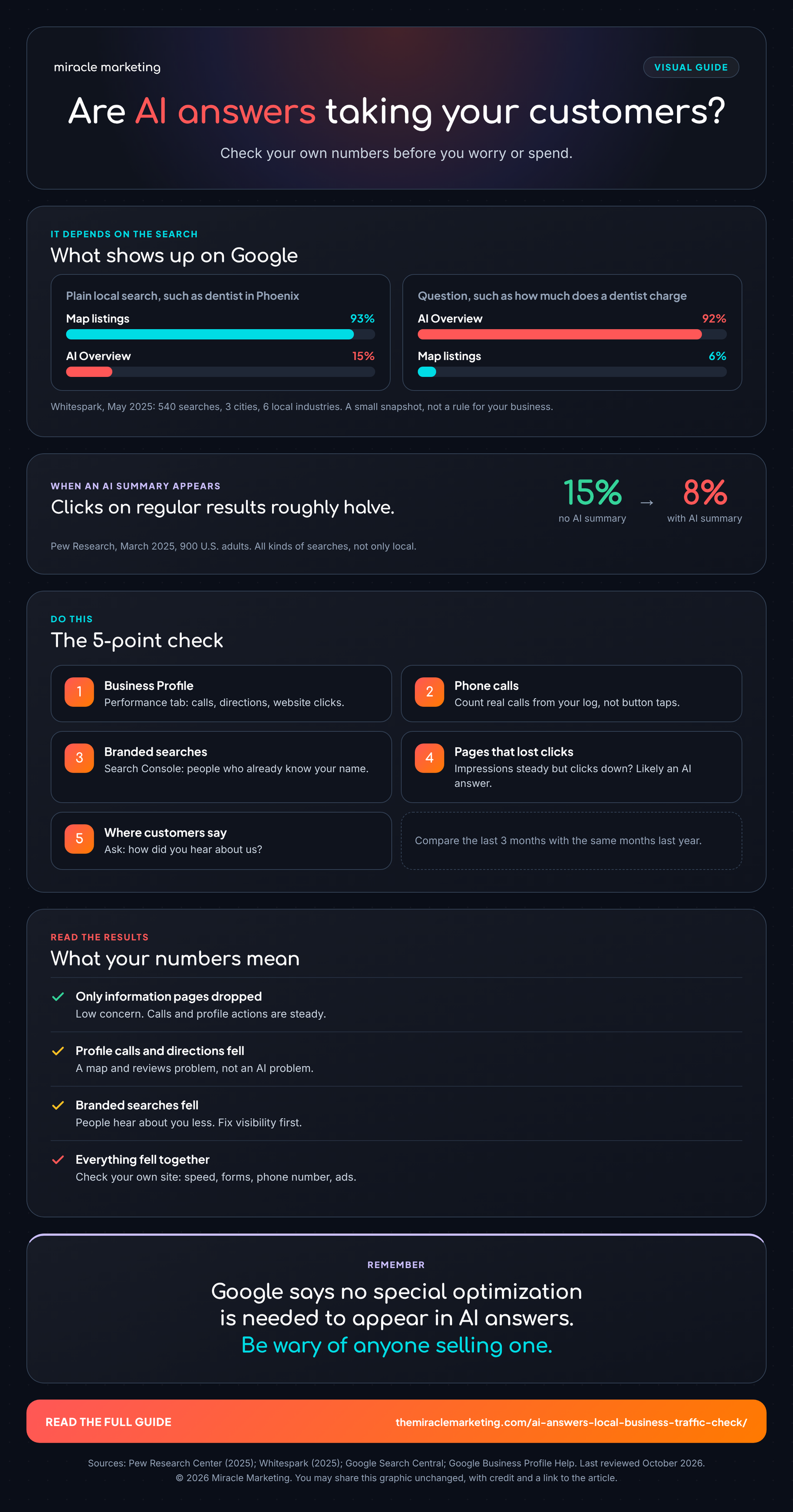
- Clicks fall when an AI summary appears. Pew Research tracked 900 U.S. adults and found 8% of visits to a Google results page with an AI summary ended in a click on a regular result, versus 15% without one. Only 1% clicked a link inside the summary. The data is from March 2025 and covers all kinds of searches, not just local ones.
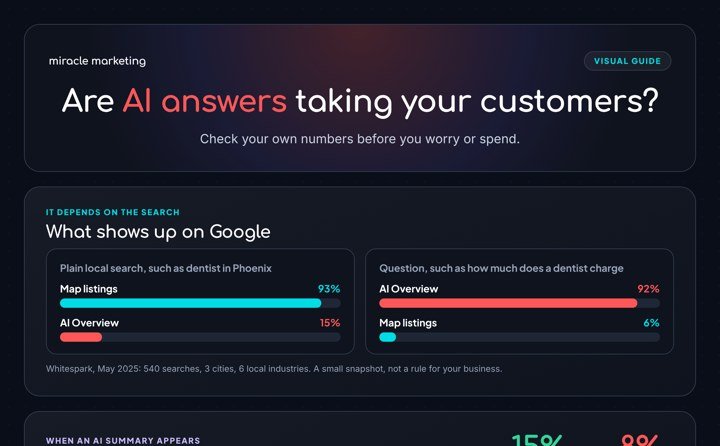
- The type of search matters a lot. Whitespark ran 540 searches for plumbers, dentists, lawyers and other local services in Houston, Phoenix and Denver in May 2025. For a plain local search such as "dentist in Phoenix," an AI Overview appeared 15% of the time and the map listings appeared 93% of the time. For a question such as "how much does a dentist charge in Phoenix," an AI Overview appeared 92% of the time and the map listings only 6%. Whitespark itself calls it a limited data set and a single snapshot.
- Many small businesses did see changes. WordStream's survey of 300 or more small businesses found about 40% reported some traffic disruption. It was self-reported and the survey did not separate AI from other causes.
Put together, the likely pattern is that blog-style, "what is" and price questions are the ones most exposed, while "near me" and "service in my city" searches have held up better. Treat that as a pattern to test on your own numbers, not a proven rule for your business.
The 5-point check
Compare the last three months with the same three months last year, because many local businesses are seasonal.
1. Your Google Business Profile
Open your profile and click Performance. Look at calls, website clicks, direction requests and messages. This is where "near me" customers land. If these are steady or rising, the people closest to buying are still finding you. Note that this data includes visits from Google Ads, so separate those if you run ads.
2. Phone calls
Count the calls you actually received, from your phone log or call tracking, not the profile's button taps. Ask your staff whether the phone has been quieter or just different.
3. Searches for your business name
In Google Search Console, open Performance, add a filter on queries and choose the branded queries option if your account shows it. Branded searches are people who already know your name. If they hold steady, your reputation is working even if general traffic shifted.
4. Which pages lost clicks
In the same report, switch to the Pages tab and compare the two periods. Look for pages where impressions held but clicks fell. Google counts AI Overview and AI Mode appearances in Search Console under the Web search type, so this is where an AI answer would show up. If the drop sits on blog and "what is" pages while service pages are flat, an AI answer is the likely cause and it is not hurting sales directly.
5. Where new customers say they came from
Add a "How did you hear about us?" question to your contact form and ask on the phone. A few weeks of answers beat any dashboard, because they include customers who found you through a chat assistant and then called.
How to read the results
- Only information pages dropped; calls and profile actions are steady. Low concern. Those visitors were rarely buying.
- Profile calls and directions fell. This is a map and reviews problem, not an AI problem. Check your hours, categories, photos and review count against nearby competitors.
- Branded searches fell. People are hearing about you less. That is a visibility problem and worth fixing first.
- Everything fell together. Look at your own site first: speed, a broken form, a changed phone number, a lapsed ad budget.
What to do if it is hurting
Google states that there are no extra requirements to appear in AI Overviews or AI Mode and no special optimization needed beyond being indexed and eligible for a snippet. Be wary of anyone selling a special "AI page" package. What helps in both Google and AI answers is ordinary: accurate business details everywhere, real reviews, and service pages that plainly answer what people ask, such as what you do, where, how much roughly, and how to book. A study by BrightLocal, which sells a tracking tool, found business websites made up about 42% of the sources AI answers cited and Business Profiles about 29%, so both are worth keeping current.
What nobody knows yet
We found no published study measuring how many calls or bookings local service businesses actually lost to AI answers. The Pew data is national and covers every kind of search, and the Whitespark sample is small and from May 2025. Google's search results keep changing, so check your own numbers again in a few months.
Our take
We build websites and lead generation systems, so we gain if you worry. We do not think you should. For most local businesses we expect the bigger leak to be what happens after the click or the call: the missed call, the slow reply, the form nobody answers for a day. Run the five checks first. If the problem is traffic, a clearer website can help. If the problem is that the leads you already get go cold, look at instant follow-up before you spend on anything else.
Sources
- Pew Research Center: Google users are less likely to click on links when an AI summary appears
- Whitespark: case study on the prevalence of AI Overviews in local search
- LocaliQ, citing WordStream's small business website trends report
- Google Search Central: AI features and your website
- Google Business Profile Help: view performance
- BrightLocal: local AI visibility study
Keep reading
Book a strategy call. We will look at how customers reach you today and tell you honestly where to start.
© 2026 Miracle Marketing. This article and its graphics are protected by copyright, so please do not copy them without permission. You may share a graphic unchanged, with credit and a link to the article.